


The 14-day Japanese diet is a way to gain weight back and get a slim figure without a debilitating fast.The approach to product selection is special.The number of calories and compatibility of components are taken into account.Fat cells disappear quickly.During the period of compliance with restrictions, you can lose 5-10 kg.
Japanese diet for 14 days: principles that influence the weight loss process
The principles for losing weight consist of 3 indicators:
- low calorie content;
- the presence of protein components in the diet;
- lack of salt in ready-made dishes.
Weight loss is triggered by an accelerated metabolic process.Protein increases heat production in the body.Cells and tissues are freed from excess fluid.This happens due to the limitation or absence of salt in food.In addition, it is possible to eliminate edema and normalize blood pressure levels, taking into account age.A minimum of calories enter the body.The amount is enough to maintain good health.To replenish energy, existing own reserves are used and activated.
Features:
- Digestion of protein foods requires energy.Fat cells are used for their formation (burning process).
- Suitable for people of different weights.
- In 7 days it takes up to 5 kg.
- Fats and carbohydrates are present.
If there are no health problems and there are no contraindications, you can continue the diet for up to 30 days.The Japanese menu is designed taking into account that at least 100 different products should appear on the table within a week.
The diet is strict.Preliminary psychological adjustment allows you to avoid unnecessary emotional stress.Experts recommend repeating the weight loss method no more than 2 times a year.
Additional effect as long as the rules are followed: the achieved result lasts a long time.To do this, it is necessary to correctly exit the diet (a sharp increase in the calorie content of food is not allowed).You need to abandon this method of losing and maintaining weight:
- pregnant women;
- breastfeeding mothers;
- people with liver diseases of varying severity;
- if there are kidney pathologies;
- for diseases of the gastrointestinal tract and stomach - gastritis and ulcers.
Limitations are also imposed by disorders in the area of cardiology.It is recommended to consult a doctor before starting the diet.
The basic principles of effective dietary nutrition
The Japanese diet for 2 full weeks has a number of principles, adherence to which will increase its effectiveness.Over the 15 years of existence, the following stand out:
- Complete absence of salt (even 2-3 g per day is not allowed).
- Reduce dietary carbohydrate intake.
- The diet consists of a variety of foods.
- Meals per day - 3.
- Quantity of liquid.
- Age criteria – 18-40 years.
- Suitable for men and women.
Here are the rules for following the diet:
- 90% of the liquid is pure water;
- Fish cooked and stewed in plates.Frying in moderation is also permitted;
- There are no restrictions on cereals, but it is recommended that rice and legumes predominate;
- vegetables, including cabbage, must be included in the menu;
- simple carbohydrates are completely excluded;
- Unsweetened kefir is allowed in the morning (for breakfast).
You cannot change the menu alone, day after day.The priority meat is beef.Chicken permitted.Do not use skin when cooking.The basis of dietary nutrition is a reduction in the daily amount of calories.No snacks are allowed.You will have to give up:
- salt (fresh foods help to eliminate excess volumes more quickly);
- smoked meats;
- fatty foods;
- ready meals;
- fast food;
- juices;
- alcoholic beverages;
- fast food and fries.
Compliance with the basic principles allows you to speed up metabolic processes in the body.Fat deposits will quickly disappear and be converted into energy.The nutrition program includes:
- eggs;
- coffee (freeze-dried is not suitable);
- Green Tea;
- chicory;
- dairy products;
- lean meat (rabbit, poultry).
Vegetables are consumed in small quantities.The amount of liquid should not be less than 2 liters per day.
Proper nutrition in the Japanese diet is based on two directions.Excessive amounts of fat and bulk are taken into consideration.If they are small, it is preferable to choose 7 days.Serious overkill will require an increase to 14 days.The main principles of nutrition during this period include:

- Prohibition of the use of alternative food products (beef cannot be replaced by pork).
- Permission to use tomato juice instead of fresh tomatoes.
- Elimination of sugar and flour in any form.
Entering and exiting the diet should be smooth.Feature: weight loss results will be less noticeable if there is another dietary restriction before the Japanese diet.It is recommended to spend a fasting day the day before starting a normal diet.Several options are allowed: use kefir or apple, eat boiled meat with fresh or boiled vegetables.Leaving the diet should be smooth.New products must be introduced gradually.It is recommended to include 1-2 species per week in your diet.The absence of salt in dishes will help remove excess fluid from tissues and cells.It accounts for up to 30% of volumes and excess weight.Selected periods of strict restrictions cannot be exceeded.You cannot rearrange the days and menus compiled for breakfast, lunch and dinner.
Pros and cons of the Japanese diet
Dietary nutrition according to the Japanese system has a number of advantages and disadvantages.They need to be taken into consideration before starting the diet.Among the advantages are:
- reducing the amount of salt in the diet leads to a reduction in the risk of developing heart and vascular diseases;
- the possibility of choosing the duration of the diet – 7 or 14 days;
- lost kg and volumes will not return if entry and exit from the diet are done correctly;
- the foods included in the diet are available to everyone (there are no unusual or exotic dishes);
- absence of edema or its elimination;
- the presence of protein ingredients does not cause sagging of the skin or the appearance of stretch marks in areas where the fat layer is reduced;
- there are no strict restrictions on cooking (food can be boiled, placed in a water bath, stewed, fried in vegetable oil);
- vitamins and microelements enter the body with plant and vegetable components.
14 days is the period considered ideal for weight loss.The body does not experience stress.Mood and vitality do not decrease.Endurance and mental activity remain at a high level.Performance indicators do not fall.
Disadvantages of the Japanese diet:
- The system should not be used for gastrointestinal diseases.
- The number of meals is limited to 3 (healthy eating involves 5-6 times in small portions).
- There are age restrictions (the diet is not suitable for the elderly).
There are contraindications to complying with the restrictions of the Japanese system.You cannot start on your own without first consulting a doctor.
Prohibited foods for the Japanese diet
The 7 or 14 day Japanese diet contains lists of foods that should be excluded from the menu.Cannot be used even in small quantities:
- salt (except in rare cases);
- homemade vegetable and fruit preparations (marinades, pickles, jams);
- alcoholic beverages;
- carbonated drinks;
- juices;
- mineral water (as it contains gases);
- wheat flour;
- pastries and bread;
- semi-finished products;
- canned foods (meat, fish and vegetables);
- confectionery products (sweets, lollipops, dragees, chocolates, cookies, pastries, cakes);
- fatty meat;
- fatty fish;
- milk;
- cereals;
- cream;
- mayonnaise;
- bananas (fresh, mashed, dried);
- khaki;
- grapes (all varieties and raisins);
- sugar (white, cane);
- flavorings;
- gelling components;
- whipped cream;
- potatoes (and other starchy vegetables);
- sauces;
- spices;
- spices.
Honey and dishes containing it are prohibited.Sausages and sausages, boiled and smoked sausages, lard cannot be consumed during this period.
Authorized Products
The following products can be used for cooking:
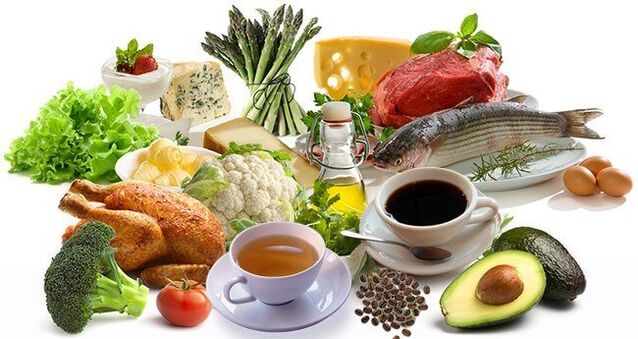
- kefir;
- yogurt without additives (organic);
- rye crackers;
- tomato juice with unsalted pulp (best to make at home);
- cheese (hard, low-fat varieties);
- marine fish;
- natural coffee (without flavorings, cream and sugar);
- beef (boiled, stewed, steamed);
- chicken (boiled, steamed);
- eggs (quail, chicken) - can be boiled, add cheese, cooking method - hard-boiled;
- zucchini;
- eggplant (can be fried);
- parsnip root;
- apples (unsweetened, green varieties);
- pears (unsweetened ones are recommended - for example, Chinese);
- citrus fruits (oranges, lemons, grapefruits, tangerines);
- green tea (no additives);
- lemon juice;
- vegetable oils (sunflower and olive) - you need to choose unrefined ones;
- cherries 50 g each;
- kiwi (take into account allergic reactions to the product);
- plum (only fresh, in small quantities);
- white cabbage;
- carrots (fresh, boiled, grated);
- rye bread;
Dishes based on meat, poultry or fish are served as a side dish.You need to include them in the menu daily.The difficulty is that you will not be able to “adapt” the flavor to what you are used to.You cannot add spices, herbs or use other methods.Salt is also not added to the dish.You cannot cook potatoes or fried kebabs in lard, but you can include steamed cutlets and meatballs in your nutritional program.
Approximate grocery shopping for 2 weeks
For 2 weeks you can buy:
- chicken eggs - 20 pieces;
- fillet or chicken breast – 900 g;
- carrots – 3kg;
- unsalted tomato juice) – 2 l;
- ground natural coffee or beans - 1 package;
- white cabbage – 2-3 kg;
- fruits – 1 kg (of choice);
- lemons – 2-3 units;
- fresh sea fish (whole carcasses) – 2 kg;
- unfrozen fish fillet – 1 kg;
- hard, low-fat cheese – 200 g;
- melons – 2 kg;
- vegetable oil – 0.5-1 l;
- lean meat – 1kg;
- green tea – 1 package (no additives).
It is recommended to purchase kefir and yogurt as needed to keep these products fresh.
Japanese diet for 14 days: menu, table
The nutritional program is based on a complete menu with a certain number of calories.Menb per day (for each of the 14):
| Diet day | Breakfast | Lunch | To have lunch |
| 1 | Coffee (200 ml) without sugar and milk or green tea of the same volume | Chicken eggs (boiled) – 2 units, white cabbage leaves steamed with vegetable oil (150 g), homemade tomato juice (200 ml) | Steamed or lightly fried fish without accompaniment (200 g) |
| 2 | Natural coffee, ground, roasted, without milk or sugar, rye bread (1 piece) | Boiled cabbage (or stewed in water with sunflower oil), fried or boiled fish, vegetable oil as a sauce (portion 200 g) | Steamed beef (slices) or veal, poultry – optional (200 g), kefir (200 ml) |
| 3 | Rye flour toast or unsalted crackers in the composition (1 piece) drink from those allowed (200 ml) | Zucchini grated and fried until golden brown in vegetable oil (unrefined sunflower) (any quantity) | Vegetable casserole with yogurt (200 g). |
| 4 | Grated carrots with lemon juice | Whole fried or boiled fish (200 g), tomato juice (200 ml) | Sliced fruit (200 g), optional – fruit salad with lemon juice dressing |
| 5 | Carrots with lemon juice | Boiled fish (fillet) and tomato juice (1 glass) | Various fresh fruits (total weight 200 g) whole fruits |
| 6 | Chicory drink (200 ml) | Boiled chicken fillet (500 g), chopped cabbage and carrot salad with vegetable oil dressing | Chicken eggs with a piece of cheese (2 pieces), fresh carrots cut into slices |
| 7 | Green tea (200 ml) without sweeteners | Steamed meat, you can beat it lightly first (200 g) | Roast beef (200 g), a glass of kefir |
| 8 | Natural coffee-based drink (200 ml) | Boiled white chicken meat (200 g), plus “vitamin” chopped cabbage salad with vegetable oil (200 g) | Quail eggs with grated cheese topping – 2 units, fresh carrots – 1 unit |
The results achieved will last 2-3 years.The average caloric value is 800-850 kcal.You need to drink more water throughout the day.It is optionally allowed to repeat the menu after reaching the 8th day of the diet.
Giving up the Japanese Diet
Food restriction rules according to the Japanese method suggest the right way out.Recommendations:

- add portions gradually;
- expand the diet without problems;
- maintain a balanced diet.
Cereals, salt and sweets cannot be included in the menu immediately.
Various contraindications
The technique is not suitable for people experiencing mental or physical stress.Children, pregnant women and the elderly should not use the diet.If less than 2 liters of fluid enters the body, dehydration is possible.If there are gastrointestinal diseases, the weight loss method cannot be used, as the menu is not balanced.People with heart and vascular diseases cannot adhere to the restrictions (more coffee).The wrong way out will lead to rapid weight gain.
The most popular recipes for Japanese dietary dishes Carrot salad recipe: 1 carrot and 10 ml of vegetable oil.Preparation: Peel the carrots, grate them on a fine grater or cut them into thin slices.Add the oil and stir.Adding lemon juice (to taste) will help add some tang.
Eggplant and zucchini baked with cheese and yogurt: zucchini and eggplant (1 piece each), cheese (50 g), chicken egg (2 pieces), natural yogurt without additives (200 ml).Preparation: Peel and rinse the vegetables.Cut into small pieces.Put it on the form.Beat the eggs and mix with the yogurt.Pour the mixture over the vegetables.Grate the cheese and sprinkle over the dish.Bake for 40 minutes.Oven temperature – 150 degrees.
Fruit salad: green apple, pear, kiwi (1 piece each), tangerine (3 slices for juice).Wash the fruits and cut into cubes.Squeeze the juice from the tangerine slices, sprinkle over the fruit and mix.
The Japanese diet for 14 days gives excellent results if you follow the recommendations.The exit should be smooth.This is necessary so that the lost kg does not return.Repetition of restrictions is allowed after consultation with a doctor and no more than 2 times a year.